For years, B2B software pricing was relatively easy to explain: choose the product, choose the tier, then pay for the people who need access.
AI is breaking that logic.
If an agent researches accounts, recommends outreach, resolves conversations, updates records or executes actions without a human logging in for every task, charging only per user no longer represents the work the platform delivers.
HubSpot has just made that shift much more concrete in EMEA.
RevOpsHubs Thesis
The CRM budget is no longer only the cost of giving software to people. It increasingly includes the cost of work performed by software and agents.
What changed in EMEA
On 2 October 2026, HubSpot began rolling out its Flexible Seats-and-Credits Pricing model in EMEA for new customers covered by the rollout.
HubSpot describes the model in three layers: hubs and editions, seats, and credits. The subscription still defines platform capability, users still receive a level of access, and selected actions now consume capacity measured in credits.
Seats change as well. For customers on the new model, the old Sales, Service and Revenue Seats are no longer the primary commercial unit. Seats are priced by the edition purchased, while Professional and Enterprise distinguish between Core Seats and Front Office Seats. HubSpot explicitly states that Front Office Seats replace Sales, Service and Revenue Seats for flexible seats-and-credits customers.
This is not just a naming exercise. Pricing is becoming less tied to which department uses the software. Platform edition matters more, while consumption starts to measure part of the work performed.
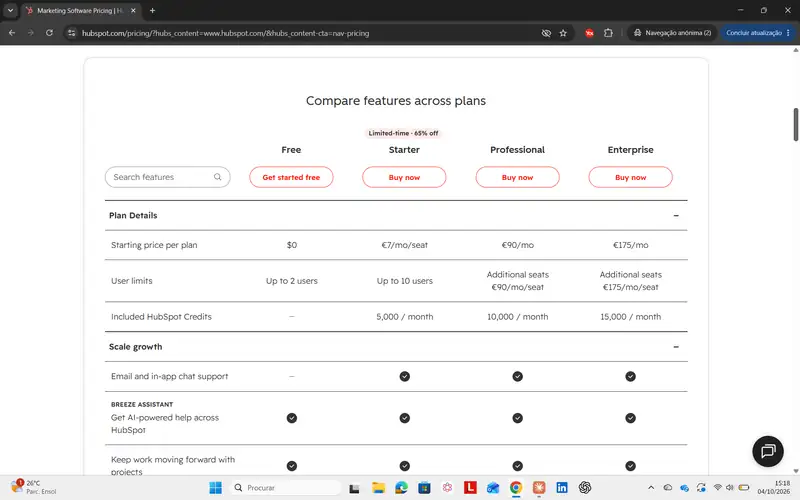
5,000, 10,000 and 15,000 included credits
Under the new EMEA model, paid editions receive a monthly HubSpot Credit allocation:
- Starter: 5,000 credits per month.
- Professional: 10,000 credits per month.
- Enterprise: 15,000 credits per month.
Credits reset monthly and unused credits do not roll over.
When usage exceeds the included amount, customers can add capacity or use Pay-as-You-Go. The EMEA supplement currently lists additional credits at €0.010 per credit.
These allocations refer to the new Flexible Seats-and-Credits Pricing rollout in EMEA. Older HubSpot pages and markets still on previous pricing may show different credit allocations.
Credits are not only an “AI allowance”
This is where the model becomes more interesting.
It is tempting to think of HubSpot Credits as a wallet for AI agents. The current rate sheet is broader. Credits can be consumed by agents, Breeze workflow actions, high-volume automation, Data Studio and other usage-based capabilities.
Examples published by HubSpot in October 2026 include:
- Customer Agent: 50 credits per resolved text conversation.
- Prospecting Agent: 100 credits per outreach recommendation for one lead.
- Data Agent: 10 credits per response to one prompt for one record.
- Breeze workflow action: 10 credits per execution.
- Standard workflow actions: variable credits per action, with lower rates at higher volume tiers.
The key shift is that cost is no longer tied only to having access to a feature. It is also tied to how often the system does work.
A Professional account with 10,000 credits could theoretically spend all of that capacity on roughly 200 Customer Agent resolutions, 100 Prospecting Agent recommendations or 1,000 Data Agent responses. Real accounts will mix use cases and rates can change, so these examples are only a way to make the scale tangible.
The official rate sheet publishes credit consumption by action. HubSpot also lets customers simulate agent runs without consuming credits and set per-agent guardrails.
Why is HubSpot doing this?
HubSpot's own explanation is straightforward: AI has different economics from traditional SaaS.
First, AI execution has variable cost. A simple generation task and an agent that researches an account, calls tools and takes multiple actions do not cost the vendor the same amount to run.
Second, there is a vendor paradox: the more productive AI makes each employee, the fewer seats a customer may need. A vendor charging only by user can end up delivering more work while collecting less revenue.
In Why AI platforms are moving to credit-based pricing, HubSpot describes this tension directly and argues that credits align price more closely with usage and work delivered.
For years we bought software for people to work with. We are starting to buy capacity for the software to work too.
Seats are not disappearing overnight. What is emerging is a hybrid model: subscription + access + consumption.
What this changes for RevOps
For RevOps, the implication is not simply “watch the invoice”.
Many automation decisions used to have close to zero marginal cost once the subscription was paid. Running another workflow or asking the platform to do one more thing rarely required a cost discussion.
Agents and metered execution bring that question back.
1. Every automation has an economic model
The question is no longer only whether a task can be automated. We also need to know the cost per execution, expected volume and the business outcome created.
2. More AI is not automatically better
An agent can perform well and still be the wrong choice for deterministic work that a conventional workflow can handle more cheaply and predictably.
This reinforces a core RevOpsHubs principle: AI readiness starts before the AI layer. The process needs to be clear enough to choose deliberately between deterministic automation, AI and human judgement.
3. Consumption needs an owner
If Marketing, Sales and Service can activate agents and actions against the same credit pool, somebody needs to own priorities, guardrails and exceptions. Otherwise, companies create a new form of operational debt: consumption without governance.
4. Cost per action is not enough. Measure cost per outcome.
A Prospecting Agent should not be judged only on credits used or leads processed. The useful measure is cost per qualified meeting, valid opportunity or incremental revenue.
The same applies in service: cost per useful resolution, reopen rate, human handoff and response-time improvement matter more than raw agent activity.
This confirms a broader change in the Revenue System
In the RevOpsHubs Revenue System Model, Automation and AI sit after Process, CRM and Data for a reason: they execute decisions designed earlier in the system.
When execution carries an explicit consumption cost, a poorly designed process does more than create friction. It can start to burn budget automatically.
An agent researching the wrong accounts, an over-broad workflow or automation running across thousands of records unnecessarily is not only a quality issue. It is an economic issue too.
RevOpsHubs Thesis
AI governance is becoming part of Revenue Operations governance. Teams designing the system will need to manage context, permissions and risk — but also consumption capacity and unit economics.
What I would do now if evaluating HubSpot
I would not start by converting every credit into currency. I would start with use cases.
- Identify 3–5 high-value workflows. Where can an agent or credit-based action genuinely remove work, improve speed or improve a decision?
- Estimate volume. How many accounts, conversations, records or executions occur each month?
- Simulate before scaling. HubSpot can test agent runs and estimate credit consumption without using the live balance.
- Set guardrails. Cap usage by agent and define who can raise limits.
- Measure outcomes, not activity. Compare consumption with time released, conversion, resolution, pipeline or revenue.
- Review after 30 days. Use the first month to learn the real consumption profile before assuming the initial allocation is right.
This discipline is new for many revenue teams. It may also be healthy: usage-based pricing forces organisations to see which automations are actually worth running.
Pricing is telling us where software is going
This HubSpot change matters even if your company does not use HubSpot.
The seat has been the dominant economic unit of SaaS because software was primarily a tool used by people.
When software starts doing work itself, seats are no longer enough.
We will keep buying access. We will also buy execution capacity.
That changes the procurement question:
How much does the software cost? → How much does it cost to produce this outcome with people, automation and agents working together?
That is a much more RevOps question.